The project

Wheatley Homes Glasgow is almost half-way through a trailblazing programme to transform the heating and hot water experience for many of its tenants.
Wheatley Homes Glasgow has a stock of 40,000 affordable homes. About a quarter of these homes are heated by electric storage heaters (ESH). Supported by the Scottish Government Social Housing Net Zero Fund, Wheatley Homes Glasgow is investing in the installation of Connected Response technology in all homes using ESH. As of January 2023, installation has already been completed in 4,000 of the 10,000 homes in question.
The problem

Traditionally, ESH and hot water have been charged overnight to take advantage of the lower Economy 7 (E7) off-peak electricity tariff. The result of this, however, has been for homes to be exceptionally warm, often uncomfortably warm, from 4am through to the early afternoon, when the stored heat is exhausted. To keep warm in the late afternoon and evening, tenants are faced with a limited number of options; all of which are far from ideal. They can switch on supplementary electric heating at the higher on-peak rate; wrap-up warm and use hot water bottles or similar; or, go to bed early.
The solution
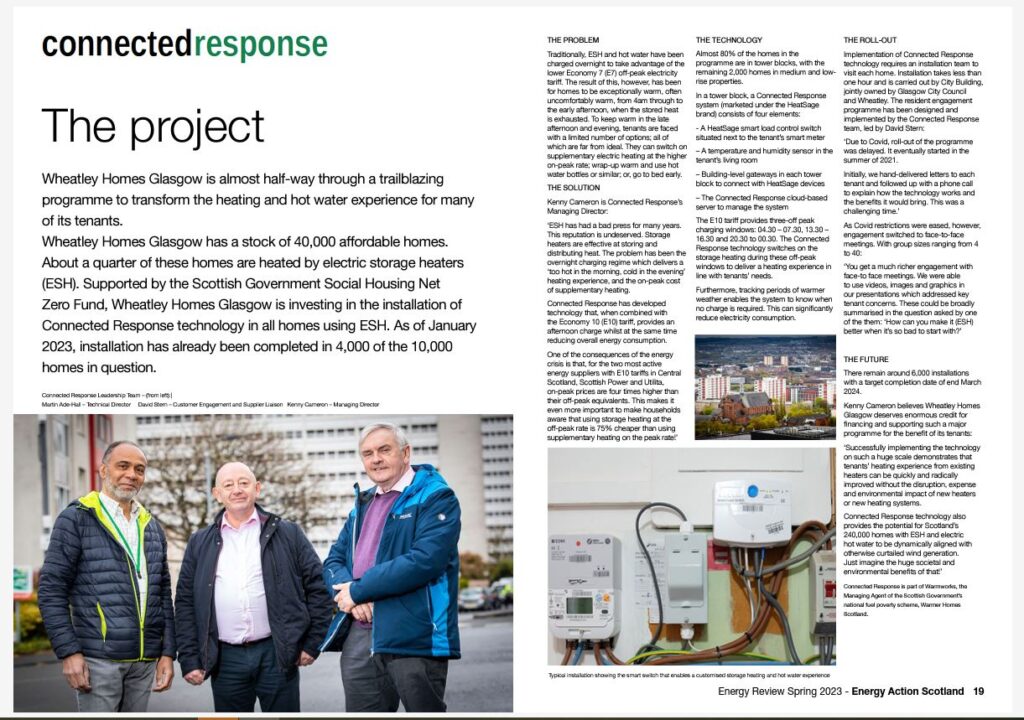
Kenny Cameron is Connected Response’s Managing Director:

‘ESH has had a bad press for many years. This reputation is undeserved. Storage heaters are effective at storing and distributing heat. The problem has been the overnight charging regime which delivers a ‘too hot in the morning, cold in the evening’ heating experience, and the on-peak cost of supplementary heating.
Connected Response has developed technology that, when combined with the Economy 10 (E10) tariff, provides an afternoon charge whilst at the same time reducing overall energy consumption.
One of the consequences of the energy crisis is that, for the two most active energy suppliers with E10 tariffs in Central Scotland, Scottish Power and Utilita, on-peak prices are four times higher than their off-peak equivalents. This makes it even more important to make households aware that using storage heating at the off-peak rate is 75% cheaper than using supplementary heating on the peak rate!’
The technology
Almost 80% of the homes in the programme are in tower blocks, with the remaining 2,000 homes in medium and low-rise properties.
In a tower block, a Connected Response system (marketed under the HeatSage brand) consists of four elements:
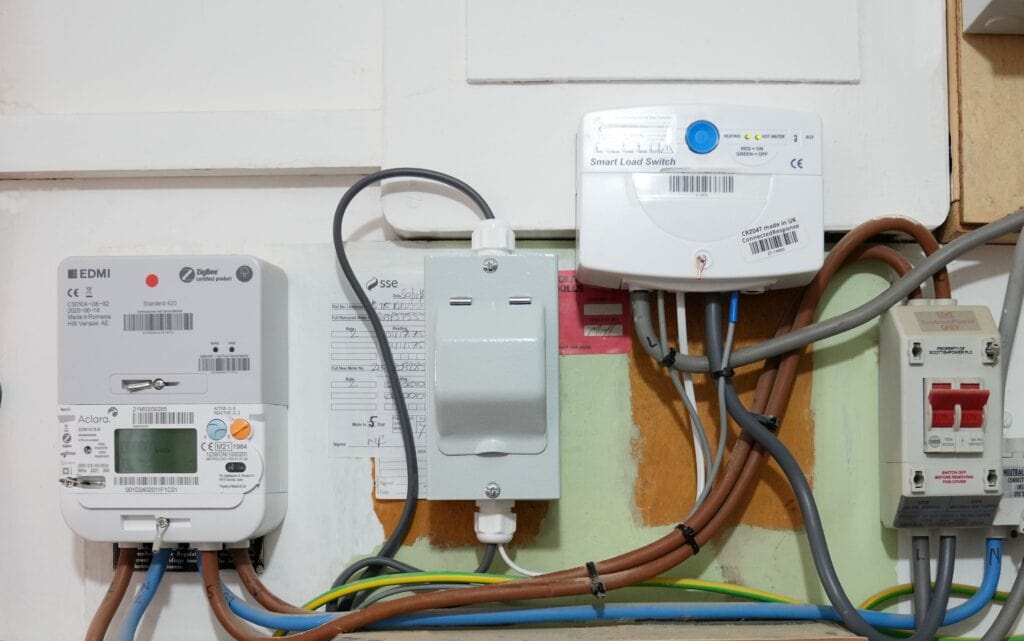
– A HeatSage smart load control switch situated next to the tenant’s smart meter

– A temperature and humidity sensor in the tenant’s living room
– Building-level gateways in each tower block to connect with HeatSage devices
– The Connected Response cloud-based server to manage the system
The E10 tariff provides three-off peak charging windows: 04.30 – 07.30, 13.30 – 16.30 and 20.30 to 00.30. The Connected Response technology switches on the storage heating during these off-peak windows to deliver a heating experience in line with tenants’ needs.
Furthermore, tracking periods of warmer weather enables the system to know when no charge is required. This can significantly reduce electricity consumption.
The roll-out
Implementation of Connected Response technology requires an installation team to visit each home. Installation takes less than one hour and is carried out by City Building, jointly owned by Glasgow City Council and Wheatley. The resident engagement programme has been designed and implemented by the Connected Response team, led by David Stern:

‘Due to Covid, roll-out of the programme was delayed. It eventually started in the summer of 2021.
Initially, we hand-delivered letters to each tenant and followed up with a phone call to explain how the technology works and the benefits it would bring. This was a challenging time.’
As Covid restrictions were eased, however, engagement switched to face-to-face meetings. with group sizes ranging from 4 to 40:
‘You get a much richer engagement with face-to face meetings. We were able to use videos, images and graphics in our presentations which addressed key tenant concerns. These could be broadly summarised in the question asked by one of the them: ‘How can you make it (ESH) better when it’s so bad to start with?’
The future
There remain around 6,000 installations with a target completion date of end March 2024.
Kenny Cameron believes Wheatley Homes Glasgow deserves enormous credit for financing and supporting such a major programme for the benefit of its tenants:
‘Successfully implementing the technology on such a huge scale demonstrates that tenants’ heating experience from existing heaters can be quickly and radically improved without the disruption, expense and environmental impact of new heaters or new heating systems.
Connected Response technology also provides the potential for Scotland’s 240,000 homes with ESH and electric hot water to be dynamically aligned with otherwise curtailed wind generation. Just imagine the huge societal and environmental benefits of that!’
Connected Response is part of Warmworks, the Managing Agent of the Scottish Government’s national fuel poverty scheme, Warmer Homes Scotland.
This article first appeared in the 2023 Q1 edition of Energy Review, the quarterly magazine of Energy Action Scotland.